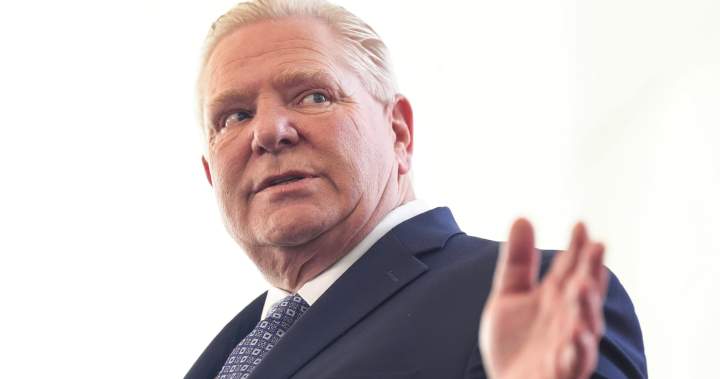
The Ford government has released the records of its private jet purchase, showing the province began buying the aircraft in January, months before it was made public.
A slew of documents dropped by the premier’s office just after 5 p.m. on Wednesday show the second-hand Bombardier Challenger 650 was billed to the government in two installments in U.S. dollars.
One invoice is dated March 2 for just over $1 million USD, while the second invoice is for March 5 at $22 million USD.
The government’s plans to buy a private jet go back even further.
One of the documents included in the release is a $500,000 USD payment, referencing a letter of intent to buy the jet dated Jan. 19, 2026.
The purchase became public months later when, over a matter of days in mid-April, the Ford government said it had taken possession of the private and then sold it again for the same $28.9 million (CAD) it bought it for.
The premier told reporters on April 22 the plane had been sold back to Bombardier, although the documents show that didn’t actually happen until April 27.

Get daily National news
Get daily Canada news delivered to your inbox so you’ll never miss the day’s top stories.
The final invoice to sell the plane back to Bombardier is dated April 24 and marked $23.7 million USD.
A briefing note included in the release says the government paid $21 million USD, excluding taxes
Premier Ford apologized for how he had communicated his plan but lamented having to sell the jet, saying it was “embarrassing” that Ontario didn’t have a plane for him or his cabinet to use.
The documents also show the government spent $190,865 on the jet beyond what it spent with Bombardier.
Around $18,000 went to an aviation acquisition expert, while another $140,000 went to aircraft management services. An external legal expert also cost the taxpayer $33,000.
The documents come after weeks of the government telling opposition critics the issue was settled.
The reassurance is a contrast to how the government had talked about the controversial purchase in recent weeks, with ministers trying to shrug it off, saying the agenda had moved on.
At the beginning of the month, Finance Minister Peter Bethlenfalvy told reporters the issue was in the past.
“We are going through a process, as the process continues, we will be transparent. That is ongoing,” he said. “But you know what, we have moved on. The premier was very categorical that he listened to the people of Ontario.”
Opposition critics had, for weeks, been calling on the premier to release the documents and prove his claim that the government didn’t lose a cent in the transaction.
© 2026 Global News, a division of Corus Entertainment Inc.
PakarPBN
A Private Blog Network (PBN) is a collection of websites that are controlled by a single individual or organization and used primarily to build backlinks to a “money site” in order to influence its ranking in search engines such as Google. The core idea behind a PBN is based on the importance of backlinks in Google’s ranking algorithm. Since Google views backlinks as signals of authority and trust, some website owners attempt to artificially create these signals through a controlled network of sites.
In a typical PBN setup, the owner acquires expired or aged domains that already have existing authority, backlinks, and history. These domains are rebuilt with new content and hosted separately, often using different IP addresses, hosting providers, themes, and ownership details to make them appear unrelated. Within the content published on these sites, links are strategically placed that point to the main website the owner wants to rank higher. By doing this, the owner attempts to pass link equity (also known as “link juice”) from the PBN sites to the target website.
The purpose of a PBN is to give the impression that the target website is naturally earning links from multiple independent sources. If done effectively, this can temporarily improve keyword rankings, increase organic visibility, and drive more traffic from search results.