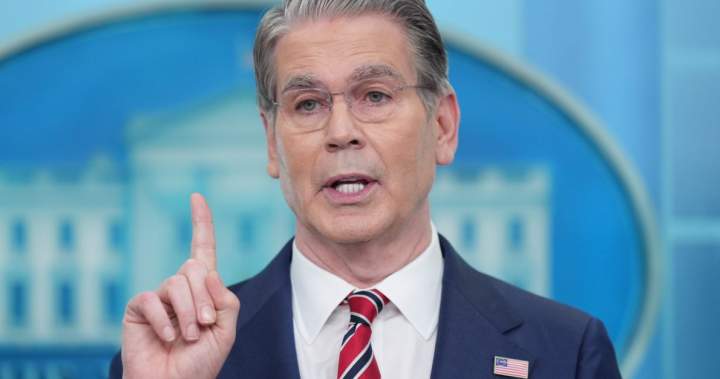
The United States will not be renewing the waivers that allowed purchase of some Iranian and Russian oil without facing U.S. sanctions, U.S. Treasury Secretary Scott Bessent told reporters on Wednesday.
Reuters reported on Tuesday that Washington would not renew a 30-day waiver of sanctions on Iranian oil at sea that expires this week, and let a similar waiver on sanctions on Russian oil expire over the weekend.
“We will not be renewing the general license on Russian oil, and we will not be renewing the general license on Iranian oil. That was oil that was on the water prior to March 11. So all that has been used,” Bessent said at a White House briefing.
The moves signal an end to the Trump administration’s efforts to use the sanctions waivers to free up more oil supplies and lower soaring global energy prices.
The Iranian waiver, which the Treasury Department issued on March 20, allowed some 140 million barrels of oil to reach global markets and helped relieve pressure on energy supply during the war, Bessent said last month. The waiver is set to expire on April 19.
Bessent said the U.S. was now preparing to further limit new purchases of Iranian oil with secondary sanctions.

Get breaking National news
Get breaking Canada news delivered to your inbox as it happens so you won’t miss a trending story.
“We have told companies, we have told countries that if you are buying Iranian oil, that if Iranian money is sitting in your banks, we are now willing to apply secondary sanctions, which is a very stern measure,” he said.
He added the measures would be “the financial equivalent” of the U.S. military’s bombing campaign against Iran.

Bessent told NBC News last week that a Treasury analysis showed that the maximum extra amount of oil revenue Russia could get would be US$2 billion.
Pressed about that figure by reporters Wednesday, Bessent acknowledged “it could have been $2 billion. We don’t know.”
“Let’s think of a different world where oil spiked to $150 (per barrel US) and they would have made a lot more by doing that, by pushing the Russian barrels that were already on the water, they were going to be sold, they were going to China no matter what,” he said.
“That we pushed it to our allies, we helped stabilize the oil price. … There were doomsday scenarios, ‘Oil’s going to $150. It’s going to $200. It’s going to $250.’”
Brent crude oil prices have fallen from their peak during the war of US$119 per barrel to above US$90 since U.S. President Donald Trump announced a two-week ceasefire with Iran and efforts to reopen the Strait of Hormuz
—With additional files from Global News
PakarPBN
A Private Blog Network (PBN) is a collection of websites that are controlled by a single individual or organization and used primarily to build backlinks to a “money site” in order to influence its ranking in search engines such as Google. The core idea behind a PBN is based on the importance of backlinks in Google’s ranking algorithm. Since Google views backlinks as signals of authority and trust, some website owners attempt to artificially create these signals through a controlled network of sites.
In a typical PBN setup, the owner acquires expired or aged domains that already have existing authority, backlinks, and history. These domains are rebuilt with new content and hosted separately, often using different IP addresses, hosting providers, themes, and ownership details to make them appear unrelated. Within the content published on these sites, links are strategically placed that point to the main website the owner wants to rank higher. By doing this, the owner attempts to pass link equity (also known as “link juice”) from the PBN sites to the target website.
The purpose of a PBN is to give the impression that the target website is naturally earning links from multiple independent sources. If done effectively, this can temporarily improve keyword rankings, increase organic visibility, and drive more traffic from search results.